Date Published: 14/11/25
Looking through the list of former pupils, my eyes were drawn to matching surnames, on further research there are two set of brothers who fought and died during the Great War...George and Frederick Annandale ...James and George McWilliam
This past week will have seen many Remembrance events to remember the Fallen in two World Wars. Many of these events will have been marked by parades and ceremonies at war memorials throughout the country and beyond.
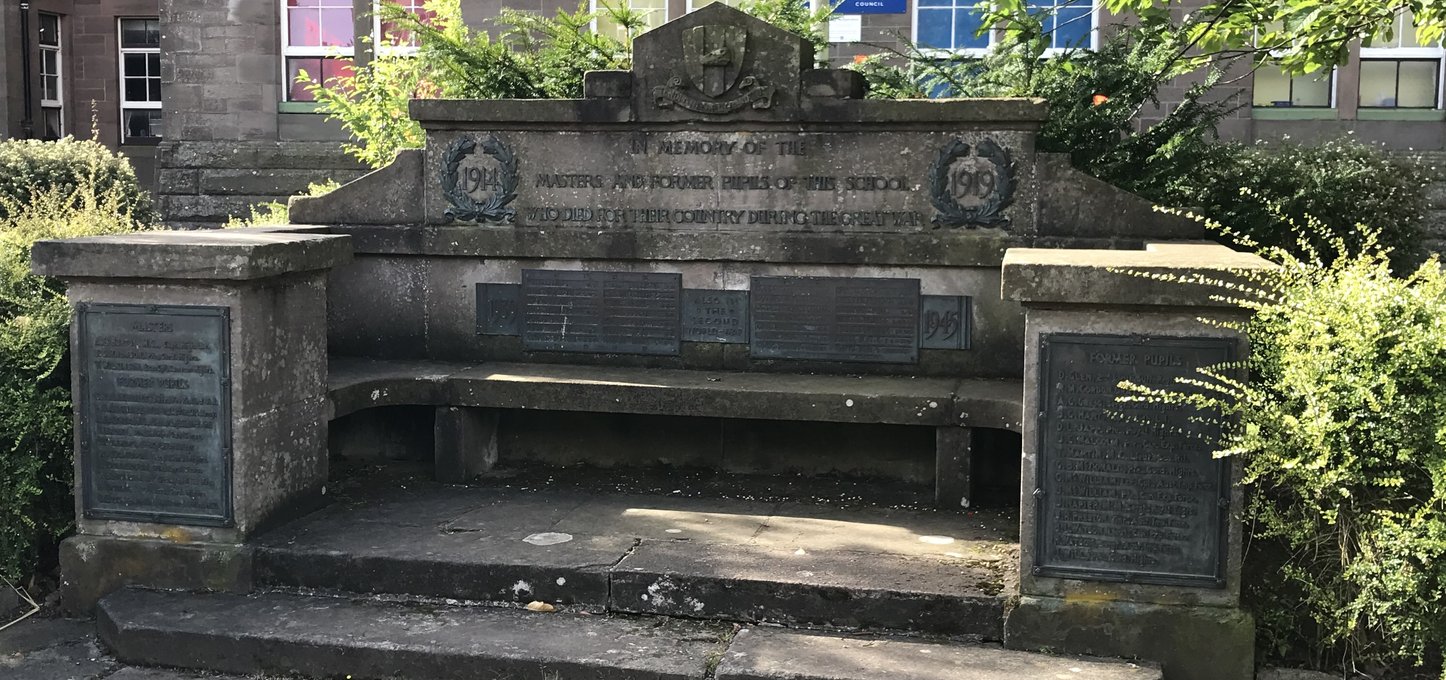
Today, I’d like to explore the memorials we are likely to see every day around about us, maybe passing them in the street, while we shop or dash for the train. I’m going to use an example of a memorial bench in Stonehaven, Aberdeenshire. However, there are many more examples about.
I used to regularly pass a bench in front of Arduthie Primary School, on the Arduthie Road, Stonehaven. I got curious one day and stopped to look at it more closely. It’s a memorial to former teachers and pupils who had attended the school, then Mackie Academy, and had given their lives for their country during both World Wars.
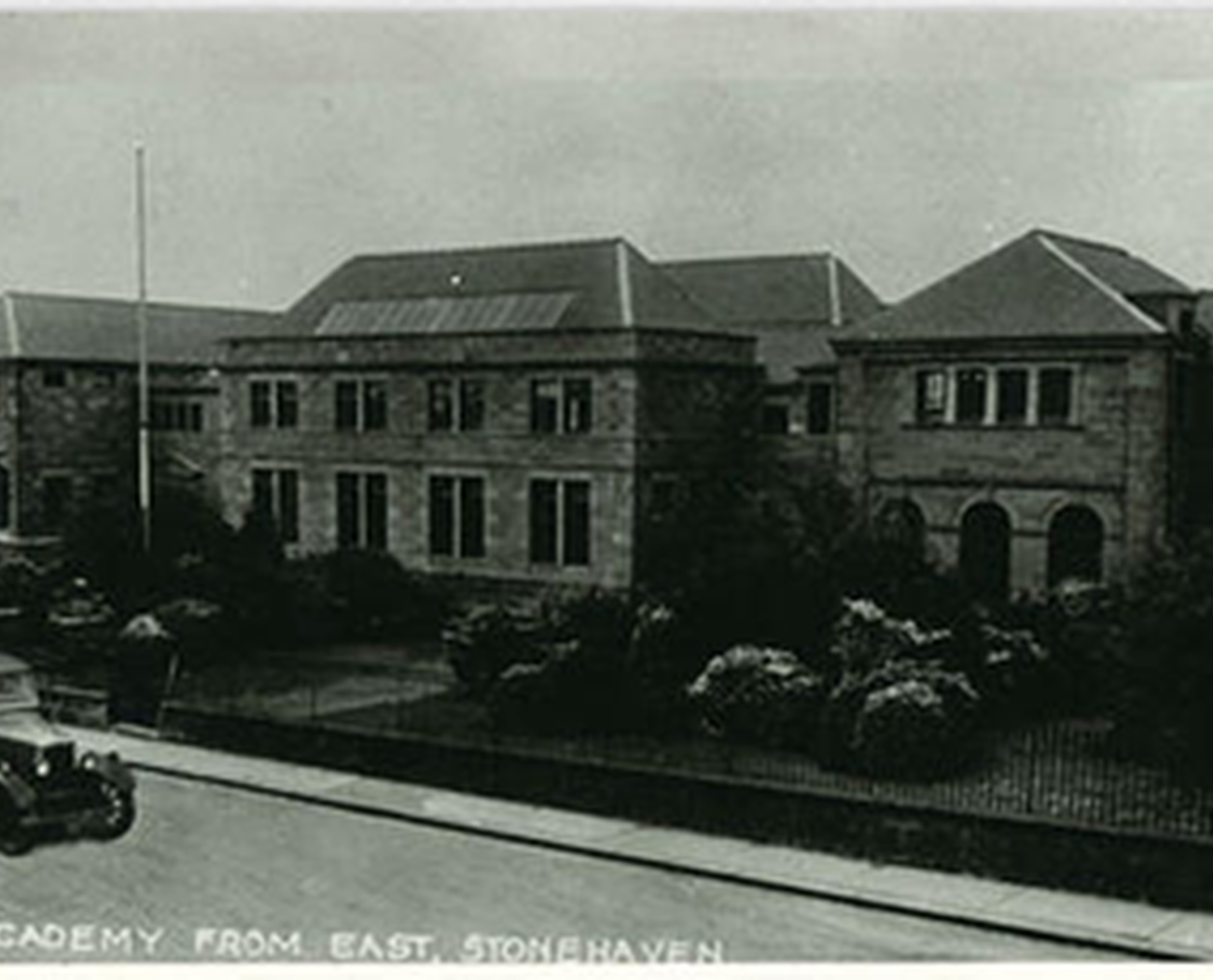
This is the best example of a photo of Mackie Academy, courtesy of the website of The Tolbooth Museum, Stonehaven.
While the town council were busy organising the construction on the main memorial for the town and surrounding area, the school committee, pupils and parents of Mackie Academy wanted to honour fallen teachers and former pupils of the school with their own memorial.
Funds were raised and a bench was designed and constructed. The architect for the Academy memorial and the Town memorial was the same man, local architect, Mr John Ellis. The construction of the memorial was done by John Blaikie & Sons (Aberdeen) and William Smith & Sons (Stonehaven). The Mackie Academy memorial was unveiled in April 1921, the town war memorial was completed just over two years later, in May 1923 on Black Hill.
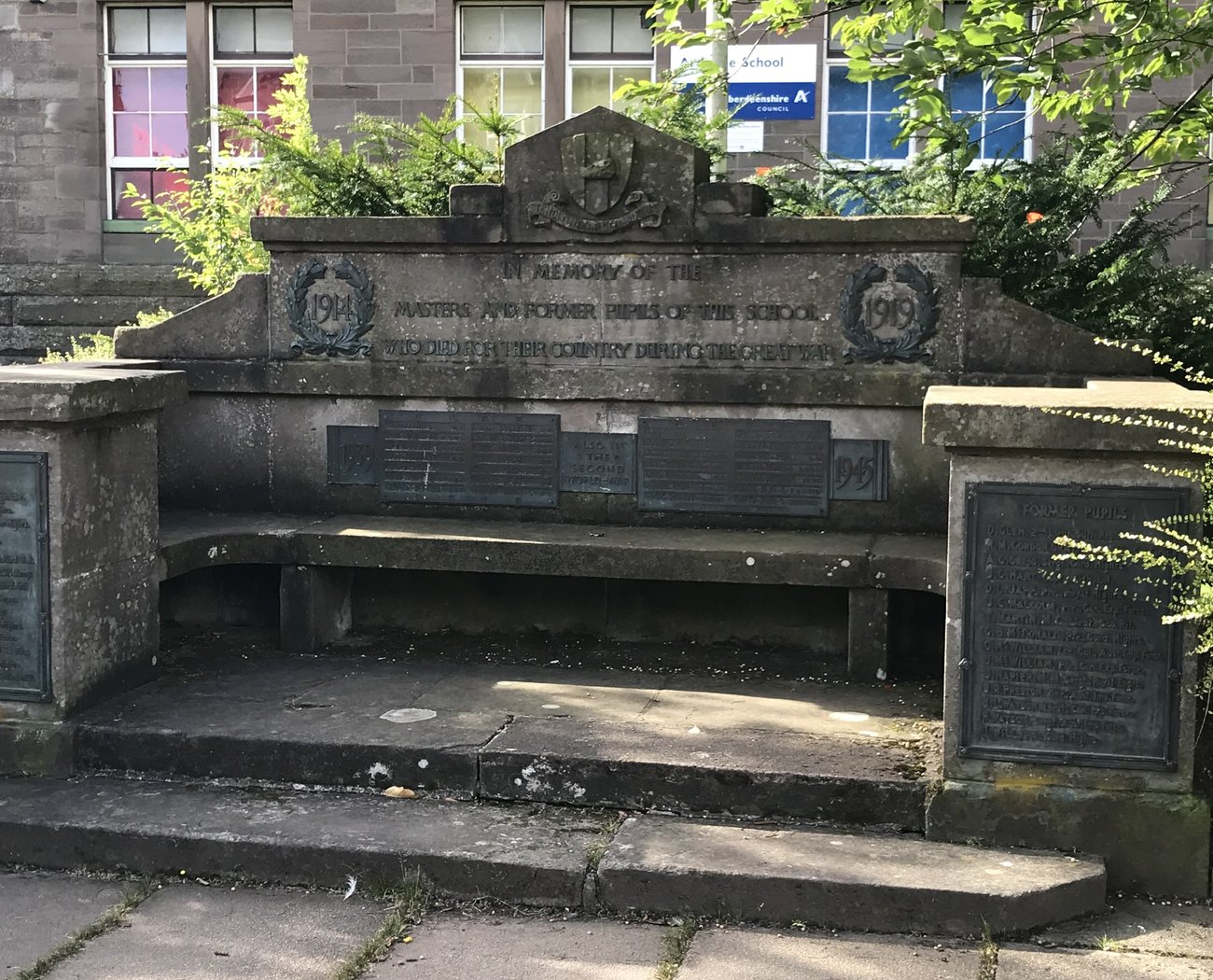
The Mackie Academy memorial is a stone bench and the wall either side of the bench shows the names of the fallen, on brass plaques. A later memorial was added to the back of the bench to honour those who died during World War Two. Once the new Mackie Academy was built, it was decided to leave the memorial is situ.
World War One
During World War One the academy lost three teachers, at the time referred to as ‘Masters’, and twenty-five former pupils. If you live in the area, you can see the men’s names listed on the copper plaques, alternatively the names were published in the ‘Aberdeen Press & Journal’, 28th April 1921, which can be accessed free of charge on the British Newspaper Archive.
As I read the list of names it was easy to see that the former pupils had travelled far and wide, by some of the countries they enlisted and fought for. America, Canada, Australia and New Zealand were all mentioned. I wanted to learn more about these men whose names have been commemorated on this memorial, the town memorials and Rolls of Honour.
Listing all the names and the details of the men’s lives would make for a very long blog, so I have selected a few. There were several sites I could have chosen to visit to find these details, big genealogy sites such as ‘Ancestry’ and ‘Find My Past’ offer free searching at this time of year. However, my favourite resource when I am researching anyone from this area is the Roll of Honour databases at the Aberdeen & Northeast Family History Society. Ann Parke, a long-standing volunteer, has produced a brilliant database of the servicemen, each listing contains a wealth of information and links to these young men’s lives, including family, memorials and newspaper articles - (https://anesfhs.org.uk/guest-home).
For example, the database list details of one of the teachers which includes where to find newspaper articles on him, in this instance, the ‘Stonehaven Journal’ (18th October 1917).
John Snadon Thomas was born in Alloa in 1891. He joined the Academy in 1913 as an assistant classics master. He was also involved with the sporting activities for the pupils and was a prominent member of the football team.
He enlisted in Aberdeen with the 2nd Battalion Gordon Highlanders at Easter of 1917, he trained during the summer and only travelled to France a few weeks before he was killed in action, on the 4th Oct 1917. He was 26 years old.
On hearing the news of his death, the school closed for the day, as a mark of respect. Private J.S. Thomas was laid to rest at the Tyne Cot Memorial listed on several local memorials and the Roll of Honour.
Looking through the list of former pupils, my eyes were drawn to matching surnames, on further research there are two set of brothers who fought and died during the Great War.
Charles & Frederick Annandale
Charles James Annandale and Frederick Napier Annandale were born in Stonehaven in 1885 and 1888. Their parents were Arthur B. Annadale and Martha (nee Napier), of Forest Hill, Stonehaven. The family lived at the North of Scotland Bank House, where Arthur was a Bank Agent. Charles and Frederick also had two other brothers – Arthur (1883-1910) and James S. Annandale (1887 - 1964). All the brothers attended Fetteresso Primary, Mackie Academy and Charles also attended Gordon’s College, in Aberdeen. James went on to study medicine at Aberdeen University and enlisted as a Lieutenant with the Royal Army Medical Corp in 1915.
Charles emigrated to New Zealand in 1903 at the age of 18, he listed his profession as a shepherd. Initially, he wanted to learn farming, however he decided to work as a contractor bush felling and road making instead. By 1911, he was working as a labourer at the Bay of Plenty.
He enlisted as a bombardier with the New Zealand Expeditionary Force in August 1914 and left for Egypt soon after. He then served with the Mediterranean Expeditionary Force and fought at Gallipoli, where he sustained some small wounds. On the evacuation of Gallipoli in Jan 1916, he returned to Egypt, embarking for France in the April of that year. He was killed in action at Mountauban, during the Battle of the Somme on the 16th of September that same year. He was 31 years old.
The De Ruvigny’s Roll of Honour contains a character quote from a comrade, Sergeant Turner “a staunch friend who you could rely upon under all circumstances. I do not think he understood the meaning of the word danger, and no matter what was doing, he would work his gun as cooly and correctly as on a drill parade.”
Frederick was the youngest brother. He initially emigrated to Halifax, Canada, where he worked as a bank teller. While in Canada he attended the Royal School of Infantry, for a few months in 1911. Frederick then moved to Sidney, Ohio, USA.
Frederick first enlisted as a Private on 19th June 1916. He was honourably discharged in December 1917, however the day after his discharge he accepted a 2nd commission as a 1st Lieutenant in the 148th Infantry Regiment of the US Army. He had made it known to several friends that he really wanted to return to his Scottish home after the war as an officer in the American Army.
Sadly, that wasn’t to be, Frederick was killed in action on the 31 Oct 1918, while his regiment fought to cross the Scheldt River, at Olsene, Belgium. He was buried at the Flanders Field American Cemetery and Memorial. He was 29 years old.
As well, as being honoured together on the memorial at Mackie Academy, both brothers are inscribed next to each other on the Stonehaven & District War Memorial.
James and George McWilliam
James and George were born in Keith, Banffshire in 1889 and 1890. Their parents farmed at Maislie Farm, and by 1901 they had moved to farm at Haughhead, Laurencekirk. Their parents, John McWilliam and his wife, Helen (nee Taylor), had eight children - five sons and three daughters. Here are James and George’s stories, using the details I first saw on the memorial.
James McWilliam, was the second eldest son in the family. He grew up working on the farm and attended Mackie Academy. After school, he may have had a career working in a bank. He completed two years training with the Territorials in Scotland prior to emigrating to Canada, about 1912.He lived in Stettler, Alberta, where he worked as a bank clerk. James enlisted into the Canadian Infantry at Calgary in February 1916. He was a private soldier in the 50th Battalion. He died of wounds he sustained fighting, on the 22nd June 1917. He was 28 years old. He was buried in Bruay Communal Cemetery Extension.
George McWilliam, was the third eldest son. Just like James, he grew up working on the farm and attended Mackie Academy. The 1911 census listed him living and working on the family farm but shortly after he emigrated to Australia with his eldest brother, John. The brothers arrived in Brisbane on the 1st September 1911, they settled and farmed at Kupunn, Dalby, Queensland. George enlisted at Toowooba with the Australian Imperial Forces on the 11 Feb 1916. He was a private in the 41st Battalion, and was promoted to Lance Corporal on the 6th Jan 1917. He was killed in action on the 8th July 1917, aged 26 years old. He was buried at the Messines Ridge British Cemetery.
James and George died within a fortnight of each other.
John McWilliam
John McWilliam, was the eldest brother, born in Keith in 1887. He had a similar upbringing to his brothers, but it doesn’t look as though he attended Mackie Academy as he’s not listed on the memorial. He had completed 5 years with the Territorial Army in Scotland, prior to his emigration to Australia. As mentioned above, he emigrated with his younger brother, George, and farmed in Queensland. He was the first of the brothers to enlist, on the 30th April 1915 at Enoggera, Queensland. He enlisted as a private and rose to the rank of corporal with the Australian Imperial Force. He was wounded on at least four occasions and was laid up convalescing somewhere in England at the time of James and George’s deaths.
Sadly, John died of wounds on the 28th April 1918, at the time he was serving in the 26th Australian Battalion. He was 30 years old. John was buried at Franvillers Communal Cemetery Extension, France.
The two youngest McWilliam brothers Norman and Leslie both survived the war.
James, George and John are all commemorated on the Marykirk war memorial.
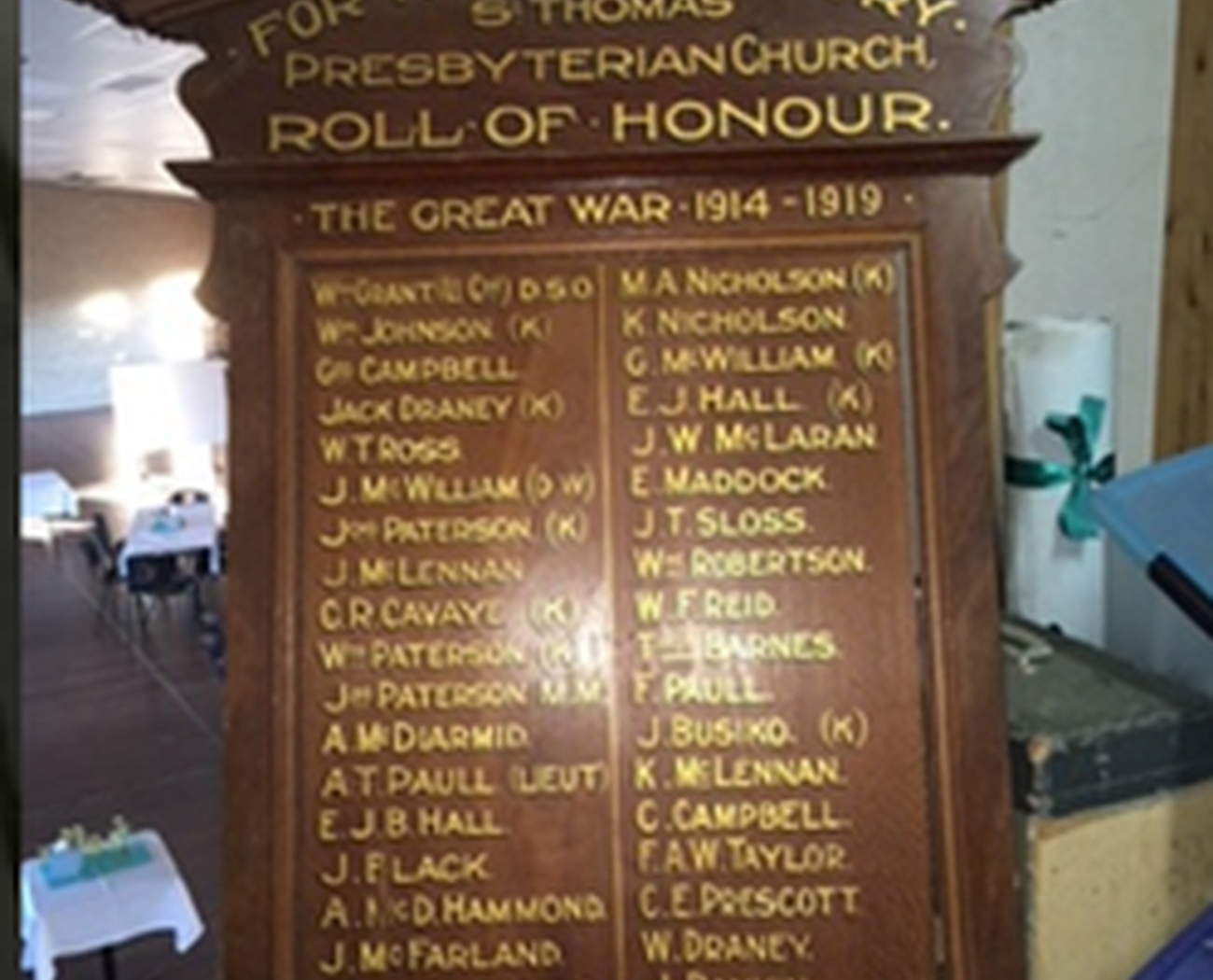
While John doesn’t appear on the Mackie Academy memorial, he is commemorated with his brother George, on ‘The Fallen’ Honour Board of St Thomas’s Presbyterian Church, Dalby, Kupunn, Qeensland, Australia.